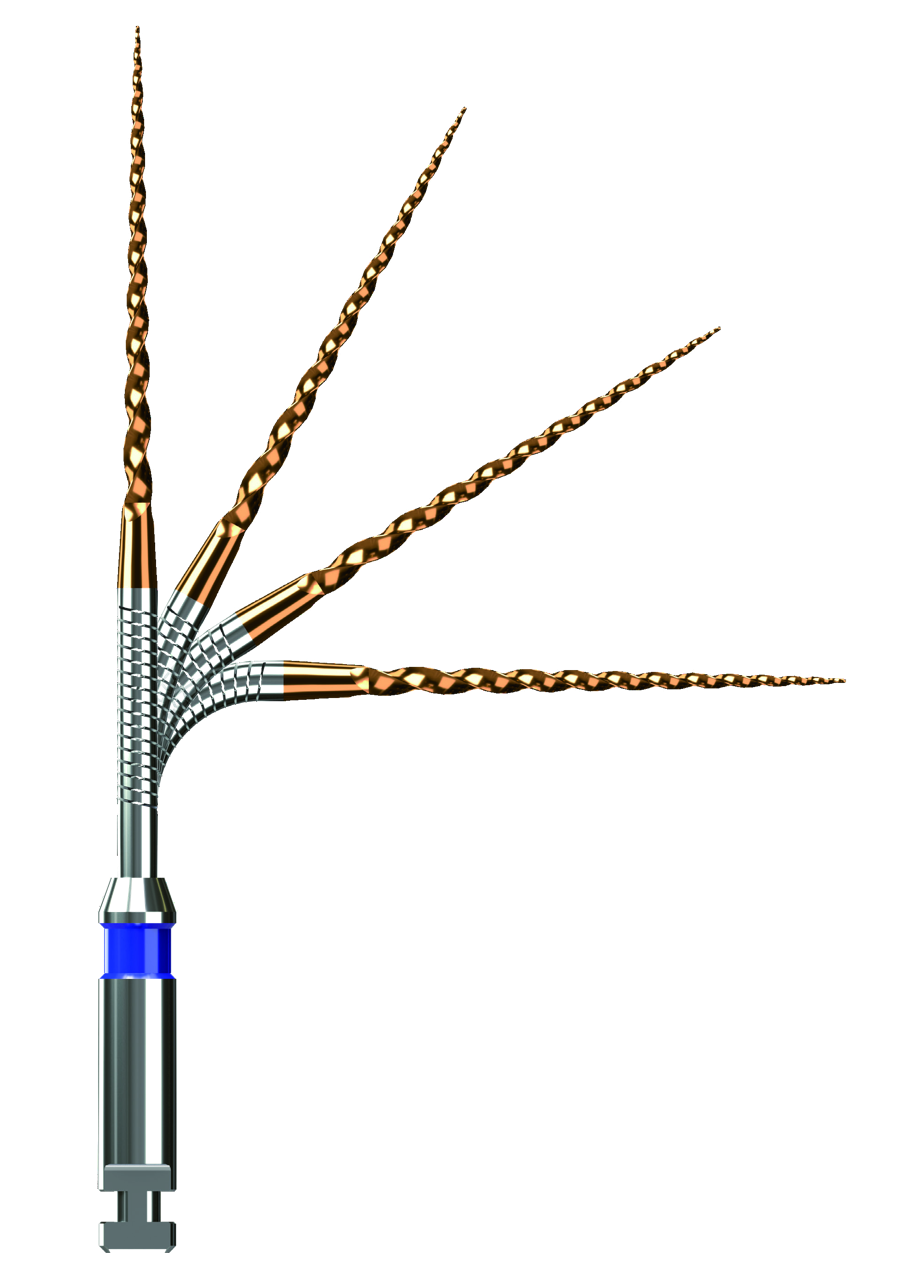
A heat-treated NiTi rotary file engineered with a unique spring structure on the shaft — minimizing file fracture and maximizing safety throughout root canal treatment.
Conventional NiTi files fracture most often at the shaft. The Spring Endo File introduces a machined spring section that absorbs and distributes load — fundamentally changing how the file behaves under stress.
SAFE
The spring structure minimizes the possibility of fracture inside the root canal. Load is distributed to the spring, and if overloaded the spring area fractures first — making the file far easier to retrieve.
EFFICIENT
Spring structure plus heat treatment improves cutting power through micro-vibration. 100% rotational torque is delivered even when the spring is bent 50–60°. Increased durability means more uses per file.
COMFORTABLE
The flexible spring makes treatment comfortable for both patient and dentist — easier for patients who cannot open wide, and no need to excessively remove tooth structure when the canal is off the central axis.
Proven Performance
Measurably More Flexible. Measurably Stronger.
Independent mechanical testing on a 25mm / #25 Spring Endo File quantifies the advantage of spring machining on the file shaft.
Unmatched Flexibility
Bending Stiffness (N) — lower is more flexible
×1.85 more flexible
52 N
Non-Spring
7 N
Spring
85% greater flexibility than non-spring products — exceptionally resistant to fracture, allowing appropriate bending under lateral forces such as a brushing motion.
Strong Resistance to Fracture
Number of Cycles to Fracture (NCF) — higher is stronger
×1.21 more resistant
~1,340
Non-Spring
~1,620
Spring
Superior fatigue fracture resistance in repeated testing within a curved root canal — a clear improvement in the ability to withstand fracture compared to non-spring products.
* Sangmi Ahn, Jung-Hong Ha, Sang Won Kwak, and Hyeon-Cheol Kim. Advancement of Mechanical Properties of Nickel-Titanium Rotary Endodontic Instruments by Spring Machining on the File Shaft. Materials 2020, 13, 5246. Bending-stiffness and NCF figures based on Denflex internal testing using a 25mm / #25 Spring Endo File.
In the Root Canal
Built for the Curves of Real Anatomy
The spring neck flexes with the natural curvature of the canal while still transmitting full rotational torque to the cutting tip — negotiating curves that would stress and fracture a rigid file.
Convex Triangular Cross-SectionMicro-Vibration CuttingShape-Memory NiTi
Flexes With the Canal
The spring section bends to follow canal curvature, reducing transportation and keeping the file centered — even in sharply curved canals.
Full Torque, Even Bent
100% rotational torque reaches the tip even when the spring is bent 50–60°, so cutting efficiency is maintained around the curve.
Heat-Treated Memory
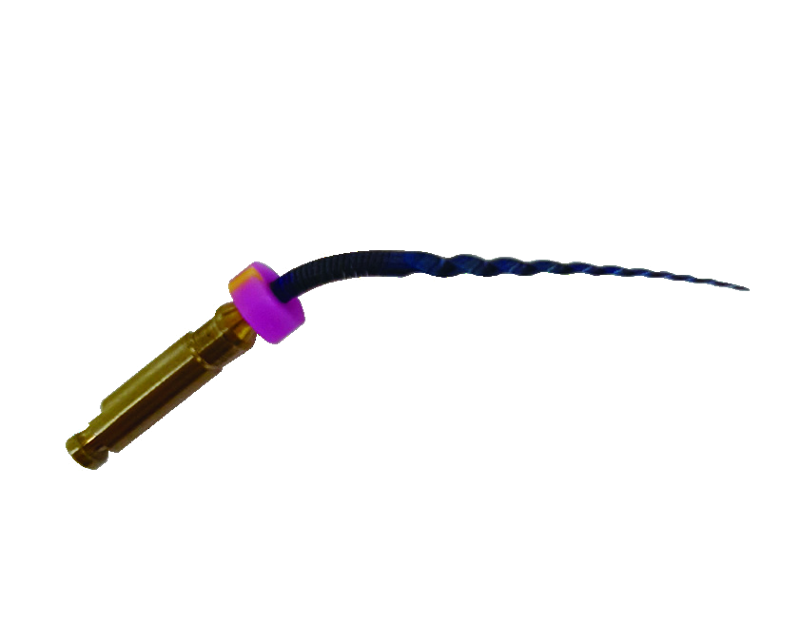
Heat-treated files behave as a shape-memory alloy — bent files return to their original shape when warmed with hot water or a dryer.
Product Reference
Spring Endo File Line-up
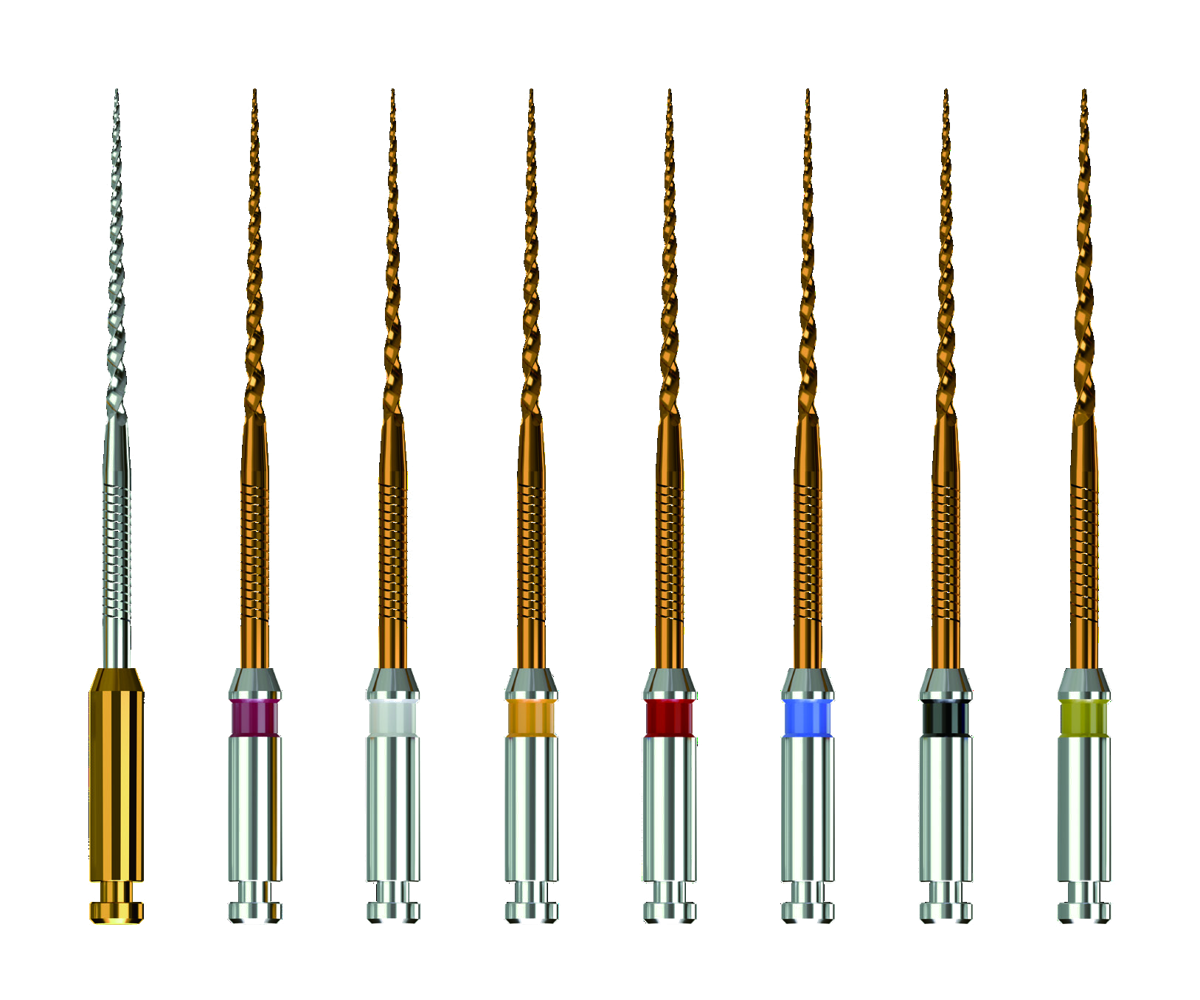
Heat-treated NiTi endodontic files in 23mm and 25mm lengths, ISO sizes from glide-path to #50. Available in Forward (DFS) and Reverse (DFSR) rotation. Each size packaged 6 files per box.
ISO Size
Color
23mm
25mm
PATH (Glide)
White
✓ Forward
✓ Forward
#10
Purple
✓ F / R
✓ F / R
#15
White
✓ F / R
✓ F / R
#20
Yellow
✓ F / R
✓ F / R
#25
Red
✓ F / R
✓ F / R
#30
Blue
✓ F / R
✓ F / R
#40
Black
—
✓ F / R
#50
Yellow
—
✓ F / R
Product Code Reference
Codes follow the pattern SFTG6HL{length}#{size}{F/R}-{finish}. Each size is offered in -S (standard pseudoelastic NiTi) and -B (heat-treated shape-memory) finishes.
Size
23mm Forward
23mm Reverse
25mm Forward
25mm Reverse
PATH
SFPATHHL23#00F
—
SFPATHHL25#00F
—
#10
SFTG6HL23#10F
SFTG6HL23#10R
SFTG6HL25#10F
SFTG6HL25#10R
#15
SFTG6HL23#15F
SFTG6HL23#15R
SFTG6HL25#15F
SFTG6HL25#15R
#20
SFTG6HL23#20F
SFTG6HL23#20R
SFTG6HL25#20F
SFTG6HL25#20R
#25
SFTG6HL23#25F
SFTG6HL23#25R
SFTG6HL25#25F
SFTG6HL25#25R
#30
SFTG6HL23#30F
SFTG6HL23#30R
SFTG6HL25#30F
SFTG6HL25#30R
#40
—
—
SFTG6HL25#40F
SFTG6HL25#40R
#50
—
—
SFTG6HL25#50F
SFTG6HL25#50R
Clinical Guidance
Tips for Using
Get the most from the spring structure. Recommended settings and handling for safe, efficient root canal preparation.
01 · START
Position on the Orifice, Then Rotate
Place the tip on the orifice before rotating. #10 or #15 files are recommended to first locate the orifice in rotation.
02 · SETTINGS
RPM 300–450 · Torque 1.0–2.0 N·m
Best cutting force range. If cutting power feels insufficient, raise the RPM or torque by one level.
03 · ROTATION
DFS Clockwise · DFSR Counter-Clockwise
Rotate DFS (Forward) files clockwise and DFSR (Reverse) files counter-clockwise.
04 · PRESSURE
No Lateral or Downward Pressure
Do not apply lateral or downward pressure while the file is rotating in the root canal.
05 · FILING
Lift Slightly While Filing
When filing in the canal, lift the file slightly toward the top for better cutting performance.
06 · ORIFICE
Expand the Orifice First
Used without orifice expansion, the tip 7–8mm can be forced by the canal — even a new file may break immediately.
07 · MAINTENANCE
Clear Cutting Residue
Remove the file periodically and clear cutting residue from the blade to maintain stable cutting performance.
08 · TESTING
Pre-Op Test on Natural Teeth Only
Administer pre-operational tests only on natural teeth. Do not test on a resin block.
09 · MATERIAL
Heat to Restore Shape
Heat-treated (shape-memory) files return to their original shape when warmed with hot water or a dryer.
New · Contact Denflex
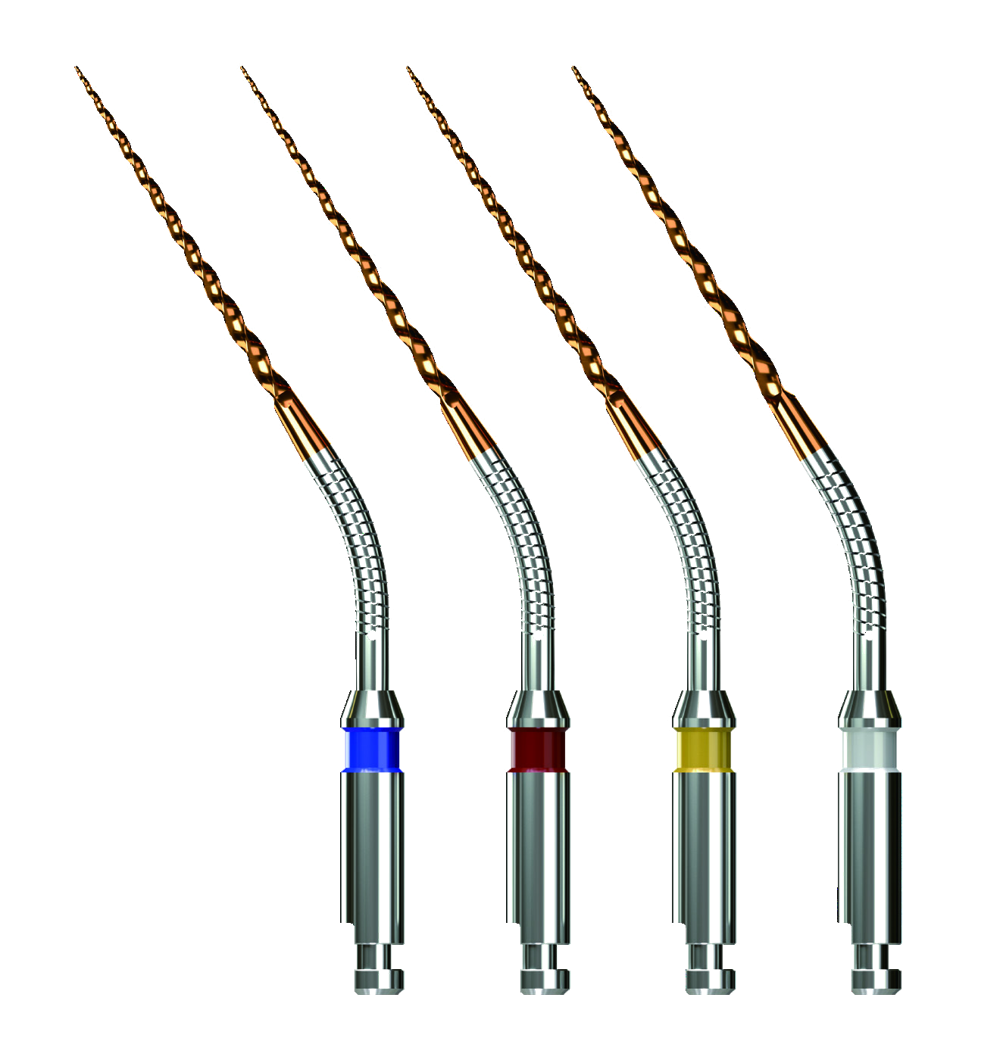
Spring Endo File Hi Plus
An optimized file for treating patients with limited mouth opening and maxillary molars. The shaft can be bent and moved into the oral cavity while maintaining the bent shape formed outside the mouth.
Pre-Bendable Shaft
Bend the shaft outside the mouth and bring it to position while it holds the curve — ideal for hard-to-reach posterior access.
Excellent in Curved Canals
Delivers excellent performance in curved root canals without breaking the file.